“At Buckinghamshire Fire & Rescue Service, our focus will always be the safety of our community. We are committed to providing an excellent, modern and agile fire and rescue service for everyone we serve. We are dedicated to having the right people, with the right skills, in the right place, at the right time to keep you safe. And together, we will continue to work to protect and safeguard people and places.
Like many other services across the country, we are facing real challenges with our On-Call fire stations and engines.
 Recruiting and keeping On-Call firefighters is harder than ever. A number of our On-Call fire engines are rarely used, and a small number have not been crewed for years. At the same time, we must make sure that we use public money wisely and adapt to new risks such as extreme weather, new housing and road developments.
This consultation sets out proposals to strengthen and modernise our On-Call service so that it remains reliable, resilient and sustainable. We want to hear your views on these proposals before the Fire Authority makes any final decisions.”
Chief Fire Officer, Louise Harrison
Buckinghamshire Fire & Rescue Service covers Buckinghamshire and Milton Keynes, an area of over 800,000 people. We currently have 19 fire stations and a workforce of around 500 firefighters and support staff.
Our crews work in two main ways:
Together, they crew a fleet of 30 fire engines and a range of specialist vehicles such as rural firefighting units, water carriers, rescue boats and turntable ladders.
We aim for our first fire engine to arrive at an incident within 10 minutes on average.
We are proud of the dedication of our staff and the support of our communities. This consultation is part of our ongoing commitment to be open and transparent about how we deliver fire cover, and to involve the public in shaping our future.
As part of our 2025 – 2030 Community Risk Management Plan (CRMP), we reviewed how many fire engines are needed to meet demand.
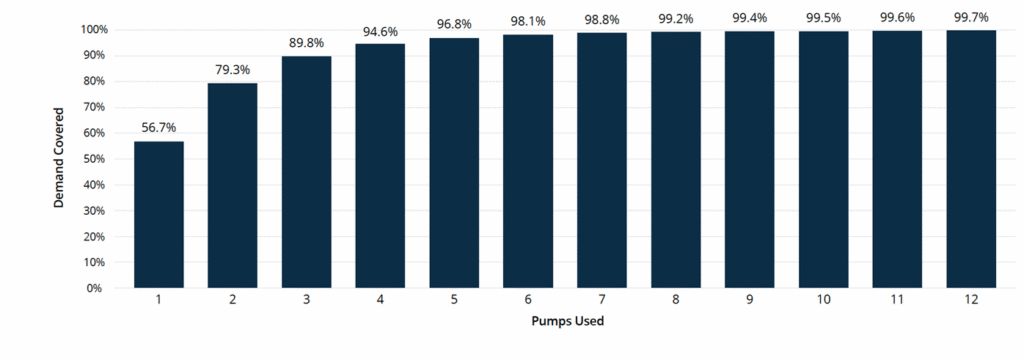
Our analysis shows that 12 immediately available fire engines is the right number to meet almost all emergencies, with over 99% of incidents managed by nine or fewer. Even at busy times, we have only needed around 20 fire engines (a mix of Wholetime and On-Call). In the last five years, there has only been one incident where more than 20 were used simultaneously.
This gives us confidence that we can meet community needs without keeping 30 pumps crewed at all times. The focus is on making sure the fire engines and vehicles we do have are in the right places and ready to respond.
Figure B shows that having 12 pumps available covers 99.7% of our demand in the four years up to 2023. This data was the foundation for building our current CRMP and response model. More recent data continues to confirm the same pattern.
Although most emergencies can be managed with fewer than 20 fire engines, we also plan for those very rare occasions when more are needed.
We do this by:
This ensures that even on the rarest of occasions, we can provide the resilience needed to keep our communities safe.
We don’t just rely on traditional fire engines. We also have a range of specialist vehicles and national support arrangements that make us more resilient when unusual or large-scale emergencies happen.
Our specialist vehicles include:
These vehicles allow us to respond more effectively and flexibly, to lessen the number of full-sized fire engines needed.
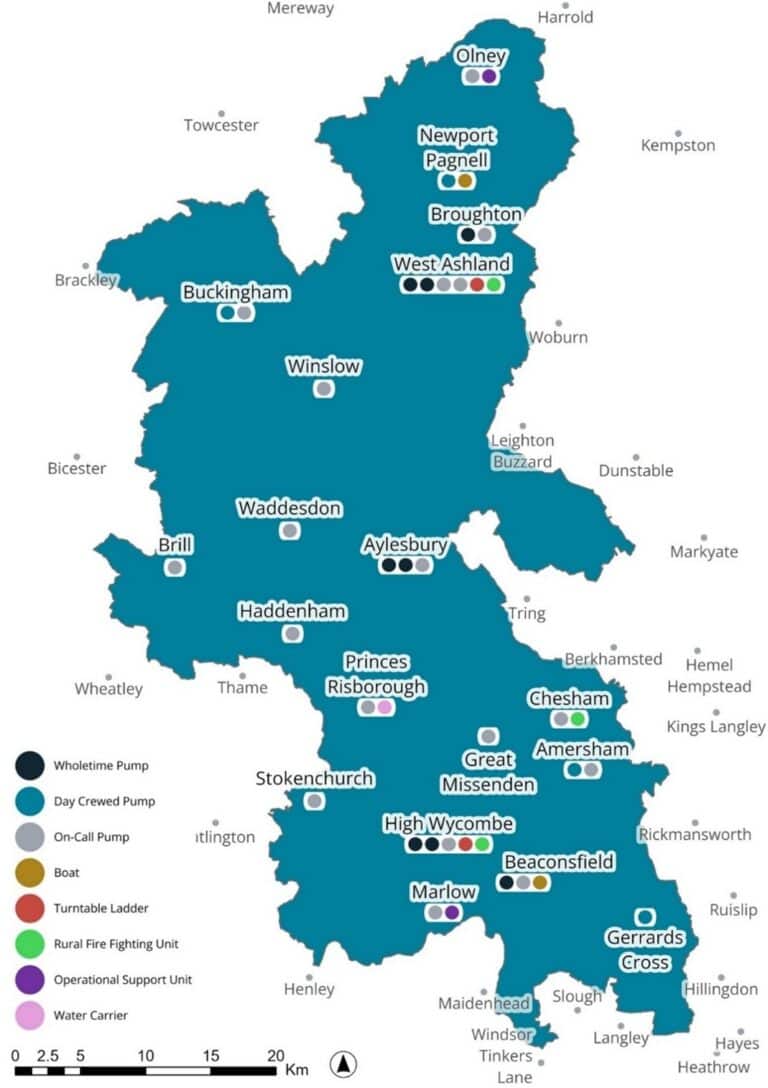
See figure A for where they are currently in the county.
We are proud to host one of only 20 national Urban Search and Rescue (USAR) bases. This national network of fire and rescue services support one another during large-scale or complex emergencies. USAR deals with collapsed buildings and other specialist rescues. Through national resilience we can provide and receive support from the national network when it is needed most.
Buckinghamshire Fire & Rescue Service needs to make changes to how our On-Call fire engines and fire stations are organised.
This programme of work is not designed to cut budgets, reduce firefighter numbers or divert resources from our frontline.
It is important to note these proposals will not cause any reduction to the public safety and protection work we carry out. Interventions relating to fire safety and fire prevention will continue to be undertaken based on risk and vulnerability.
We are consulting on proposals to:
Streamlining our On-Call fleet will provide opportunity to reinvest savings back into our On-Call provision and realign resources to improve availability and resilience.
It will enable us to use our budget more effectively and invest where it will have the greatest impact on frontline response and improvement and modernisation of station facilities, vehicles and equipment.
We will still provide strong fire cover across Buckinghamshire and Milton Keynes.
99.7% of emergencies can be met with our 12 wholetime fire engines, which are always crewed. Even at times of high demand, we can meet the needs of our communities with 20 fire engines, made up of both Wholetime and On-Call crews. It is very rare that more are needed. As demonstrated in our CRMP, Only once in the five year period did we need more than 20 fire engines at the same time.
We have carefully reviewed the impact on the affected communities. These proposals wont negatively impact our ability to meet our response standard and we also expect to see greater resilience for dealing with less frequent, high impact events and incidents. This is because the changes are designed to make sure our On-Call fire engines are more consistently crewed and specialist vehicles are in the right places to respond when needed.
Your views are essential in helping us understand the perspectives from communities before any decisions are made.
Further key points are:
We want to hear your views on these proposals. Your feedback will help us understand what matters most to local people and will be considered before the Fire Authority makes any final decisions.
If you would like more detail on the proposals, including the data and the reasons behind them, you can find this further on in this pack and in our supporting Evidence Pack.
If you’re viewing an electronic copy of this document, you can respond online by following the link below.
Participation is open to anyone (under-16s should be supported by a parent or guardian), including individuals, businesses, public and voluntary organisations, and our own staff. If you’re responding on behalf of an organisation, your feedback will be attributed to that organisation.
If you have any questions about the survey, or would like this document or the questionnaire in a different format, please email us at: OIP@bucksfire.gov.uk
You can have your say by:
Buckinghamshire Fire & Rescue Service is proud to serve our communities, but we are facing challenges that mean we must look carefully at how we provide cover in the future.
Some of our On-Call fire engines are not being used as often as they once were. A number are rarely crewed, and a small number have not been crewed for years. This is mainly because it has become harder to recruit and retain On-Call firefighters, as fewer people live and work close enough to their local fire station to respond when alerted.
Figure C shows how the availability of our On-Call fire engines has fallen sharply over the past decade, from more than 50% in 2011/12 to under 15% in recent years. This means many On-Call fire engines are not crewed when needed.
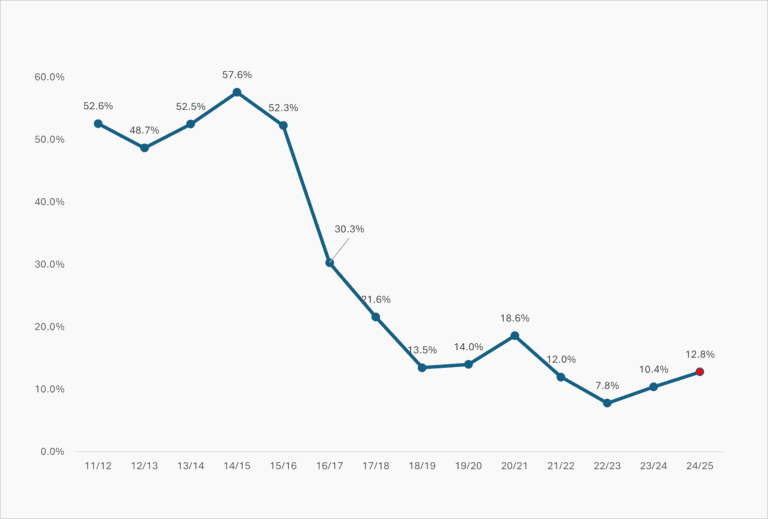
Over the last decade On-Call fire engines have become less consistently crewed. This is not about demand, but about difficulty recruiting and retaining people who can respond quickly enough. It means that some On-Call fire engines are rarely, if ever, available.
Across the county, we aim to reach emergencies in 10 minutes on average. In urban areas this is often quicker, while in more rural areas it can sometimes take longer. Wholetime fire engines are always crewed and ready to respond immediately, giving them the best chance of meeting this target.
On-Call fire engines, however, can only achieve a 10-minute turn-in time around 7% of the time on average. This figure only reflects the time it takes On-Call firefighters to get to the station and the fire engine leaving. When travel to the incident is added, the majority of these cases will not meet the overall 10-minute response standard.
Figure D shows that our On-Call fire engines are rarely ready to respond to an emergency within 10 minutes, and are much more likely to take longer than 20 minutes, or not be crewed at all.
The data in Figure D was calculated using a different method than in Figure C, so the average availability percentages will differ by 0.3%, deemed to be insignificant.
Figure D, On-Call Fire Engine Availability in Tax Year 2024/2025
Available in | 10 minutes | 20 minutes | 1 hour | 3 hours |
|---|---|---|---|---|
Average | 7.2% | 0.8% | 1.9% | 2.6% |
Broughton | 7.5% | 0.6% | 1.1% | 0.2% |
Olney | 21.9% | 0.7% | 5.3% | 14.5% |
West Ashland 1 | 18.4% | 0.5% | 1.3% | 0.3% |
West Ashland 2 | 0.2% | 0.0% | 0.0% | 0.0% |
Aylesbury | 10.2% | 0.3% | 0.9% | 1.4% |
Buckingham | 14.9% | 0.7% | 0.1% | 0.1% |
Winslow | 18.1% | 3.6% | 6.5% | 4.3% |
Brill | 2.2% | 0.1% | 0.2% | 0.1% |
Waddesdon | 12.0% | 2.7% | 10.1 | 18.4% |
Haddenham | 0.0% | 0.0% | 0.0% | 0.0% |
Amersham | 0.7% | 0.1% | 0.0% | 0.0% |
Chesham | 3.1% | 0.3% | 0.4% | 0.4% |
Great Missenden | 0.0% | 0.0% | 0.0% | 0.0% |
High Wycombe | 2.7% | 0.0% | 0.2% | 0.0% |
Princes Risborough | 7.9% | 3.8% | 7.3% | 6.4% |
Stokenchurch | 0.0% | 0.0% | 0.0% | 0.0% |
Marlow | 8.5% | 0.6% | 0.4% | 0.5% |
Beaconsfield | 1.1% | 0.0% | 0.1% | 0.0% |
On-Call crews remain vital for resilience and support, especially at bigger or longer incidents. However, they cannot be relied upon as the first fire engine at an emergency. This is why we believe changes are needed to how On-Call fire engines are organised, so we can provide more cover where it is needed most.
The risks we face are not the same as they were 10 or 20 years ago. At the same time, an ageing population means we are seeing different risks, from mobility-related rescues to medical emergencies. Climate change is also affecting us, with more grass fires during hot summers and greater risk of flooding during heavy rainfall.
Our work is no longer just about fighting fires. That’s why traditional fire engines are not always the right answer for the risks and incidents we face today.
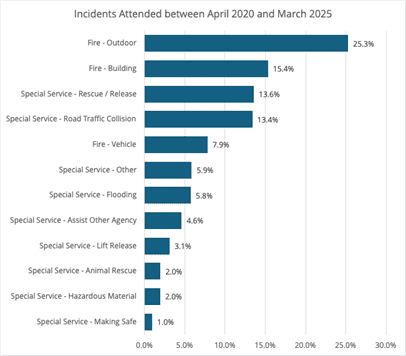
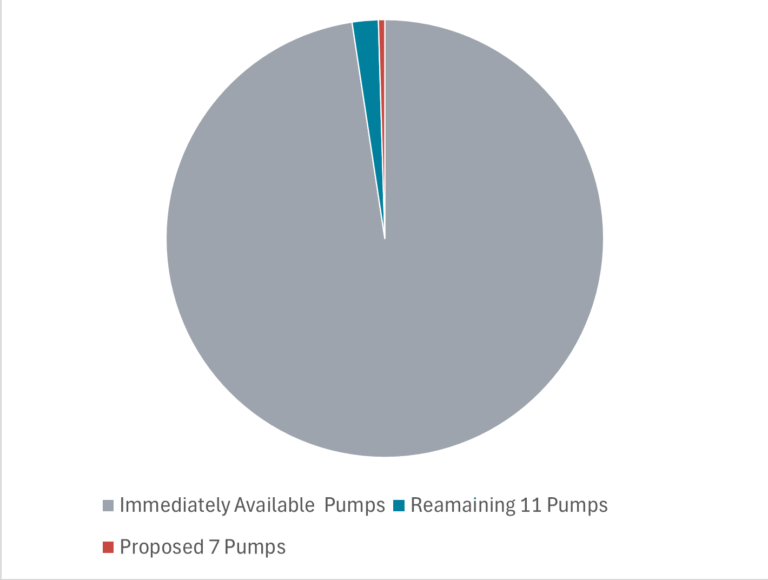
Figure F shows actual On-Call fire engines going to incidents (2020–2025). This chart shows that almost all incidents are attended by immediately available (wholetime) fire engines. On-Call pumps are mobilised much less often.
The risks faced by our communities are becoming more complex. This means we need to adapt our Service, making sure fire engines, specialist vehicles and crews are placed where they can respond to the risks most likely to happen in the future.
We have a responsibility to use our people, fire engines, and specialist vehicles in the most effective way. This means:
On-Call firefighting is a national challenge. The traditional On-Call system no longer reflects the way people live today. In many rural areas the pool of potential recruits is small, and across all communities people have less free time to commit. This makes it harder to recruit and retain On-Call firefighters, and to crew every On-Call fire engine. We face the same challenge. Each fire engine must have a minimum of four firefighters, including people with specific skills such as driving and incident command. At the moment, we have more On-Call fire engines than we can regularly crew, which means some vehicles are unavailable even though we still have firefighters in the system.
Figure G shows how often On-Call fire engines are available as 1st line (ready within 10 minutes), 2nd line (within 20 minutes), 3rd line (within 1 hour), or 4th line (up to 3 hours). Stokenchurch and Great Missenden show availability due to two occasions where the fire engines were used for standby activities and training respectively.
This highlights that while we have On-Call fire engines across the county, many of them are not available quickly enough to be the first fire engine at an emergency. Instead, a number are only available after longer periods, meaning they are less reliable for immediate response but still valuable for resilience at larger or extended incidents.
This is not about cutting the cover we provide or cutting firefighter numbers. It is about making every fire engine and vehicle count. We are committed to making the best use of our firefighters’ skills and reinvesting in the remaining On-Call stations, training, and firefighter numbers. This will help improve reliability and strengthen the role of On-Call in our Service, while keeping our ability to scale up when larger or multiple incidents happen.
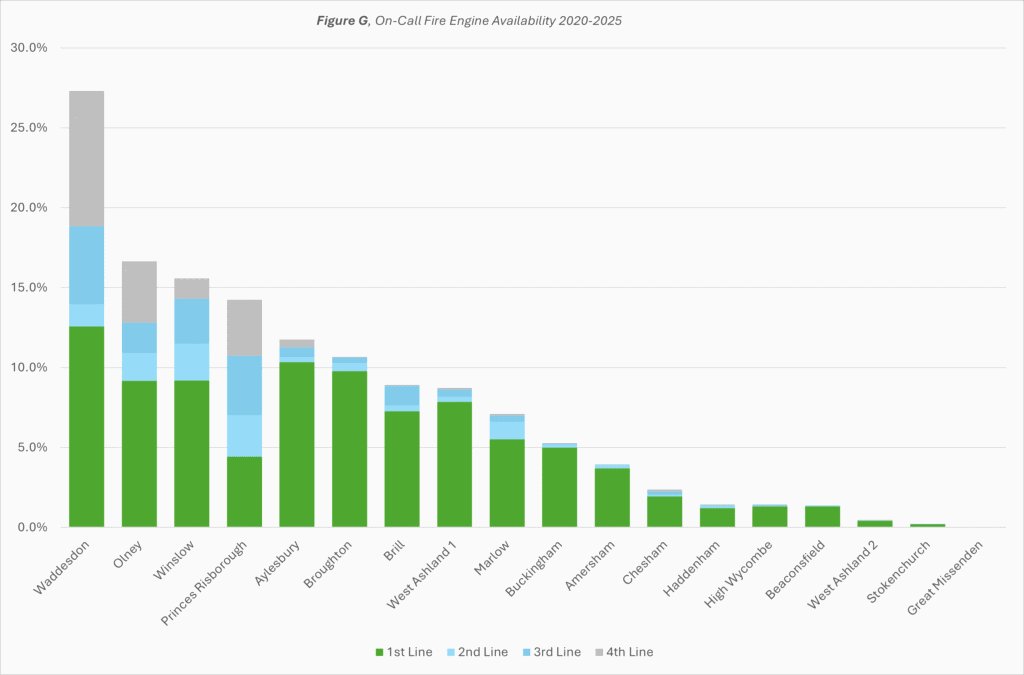
The data shows that only a small proportion of On-Call fire engines are crewed as 1st line and ready to respond within 10 minutes. Most are not available until later, as 2nd, 3rd or 4th line fire engines, which reduces their usefulness for urgent emergencies. This underlines the challenge of relying on the current On-Call system for fast first response.
We are proposing changes to how some of our On-Call fire engines and stations are organised. A number of On-Call fire engines are rarely crewed, and some not at all, while risks in our communities continue to grow and change.
These proposals are about delivering on our promise:

A modern, agile fire and rescue service with the right people, in the right place, with the right equipment at the right time. Keeping our communities safe.
We based our proposals on:
Station Name | Proposal | Community Outcome |
|---|---|---|
Great Missenden |
| Our analysis shows this change will not slow down fire engine response times |
Stokenchurch |
| Our analysis shows this change will not slow down fire engine response times |
A full review of all stations listed below in alphabetical order, including financial implications, staffing figures and demand modelling, is set out in the evidence pack (see page 31).
Station Name | Proposal | Reasoning | Community Outcome |
|---|---|---|---|
Amersham | Remove 1 On-Call fire engine
Replace with Rural Firefighting Vehicle
|
| Our analysis shows this change will not slow down fire engine response times |
Beaconsfield | Remove 1 On-Call fire engine
Replace with Crew Welfare Unit
|
| Our analysis shows this change will not slow down fire engine response times |
Buckingham | Remove 1 On-Call fire engine
Replace with Rural Firefighting Vehicle
|
| Our analysis shows this change will not slow down fire engine response times |
High Wycombe | Remove 1 On-Call fire engine |
| Our analysis shows this change will not slow down fire engine response times |
West Ashland | Replace 1 On-Call fire engine with new Water Carrier
Move Rural Firefighting Vehicle to Broughton
|
| Our analysis shows this change will not slow down fire engine response times |
These proposals do not involve any cuts to firefighters or Wholetime fire engines. All of our wholetime fire engines will remain fully crewed and available 24/7.
In some places, we may make better use of our On-Call firefighters by focusing them across fewer fire engines, or by introducing specialist vehicles that require smaller crews. This means the crews we have are ready when you need them most
Every emergency is different, and our ability to respond quickly depends on having the right people, vehicles, and equipment in the right place at the right time.
At present, many operational decisions, such as redeploying fire engines, require approval from the Fire Authority. This can create delays when swift action is needed.
His Majesty’s Inspectorate of Constabulary and Fire & Rescue Services (HMICFRS) has recommended giving Chief Fire Officers greater operational independence. This would allow them to make strategic decisions about resources more quickly, while the Fire Authority retains oversight and accountability.
Granting the Chief Fire Officer (CFO) greater operational independence would enable evidence-based decisions to be made more swiftly on matters such as fleet deployment, staffing, and equipment. For example:
We are asking for your views on giving the CFO greater operational independence. This would:
These proposals are designed to give Buckinghamshire and Milton Keynes a fire and rescue service that is modern, agile, and better matched to today’s risks. They will help us make the most of our people and equipment, while keeping communities safe.
The key benefits are:
We know people want to understand what these changes mean for emergency response. That’s why we tested different scenarios using detailed modelling.
The key finding is clear:
This means the upward benefit outweighs the downward risk, because concentrating resources on fewer, better-staffed appliances gives us more reliable cover. The full station-by-station modelling is published in the Evidence Pack.
The consultation is open to everyone, whether you live, work, or travel through Buckinghamshire or Milton Keynes. There are no age limits, although responses from under-16s should be supported by a parent or guardian. We want to hear from residents, businesses, partner organisations, and anyone with an interest in how we keep our communities safe.
All responses will be collected, analysed, and presented to the Fire Authority. Your views, alongside the evidence in this pack and the supporting Evidence Pack, will help shape the final decision.
The consultation closes 11.59pm on January 28, 2026. Please make sure you have your say before then.
Appliance – Another word for a fire engine or specialist fire vehicle.
Availability – The percentage of time a fire engine is crewed and ready to respond to an emergency.
Chief Fire Officer (CFO) – The most senior officer in Buckinghamshire Fire & Rescue Service, responsible for leading the Service and making operational decisions.
Community Risk Management Plan (CRMP) – A five-year plan setting out how the Service will assess and manage risks across Buckinghamshire and Milton Keynes.
Crew Welfare Unit – A specialist vehicle providing facilities such as rest, refreshments, and toilets to support firefighters during long or challenging incidents.
First pump / second pump – The first or second fire engine sent to an incident.
Mutual aid – An arrangement where fire services share resources and support one another during large or simultaneous emergencies.
National resilience – The ability of UK fire services to provide and receive specialist support during national emergencies, such as large fires, terrorist attacks, or natural disasters.
On-Call firefighter – A trained firefighter who usually has another job but responds to emergencies when available, normally from home or work near their station.
On-Call fire engine (On-Call pump) – A fire engine crewed by On-Call firefighters rather than full-time (Wholetime) firefighters.
Operational independence – The ability for the Chief Fire Officer to make quicker, evidence-based decisions about staff, vehicles, and resources, while the Fire Authority retains oversight.
Operational Support Unit (OSU) – A van carrying specialist equipment for use at complex or large incidents.
Resilience – The ability of the Service to deal with multiple, long-lasting, or large-scale emergencies.
Response time – The time taken for a fire engine to arrive at an incident after being called. The Service aims for the first fire engine to arrive within 10 minutes on average.
Specialist vehicles – Vehicles designed for specific types of incidents, such as Turntable ladder platforms, water rescue boats, or welfare units.
Wholetime firefighter – A firefighter employed full-time, permanently based at a station, and always available to respond immediately.
Wholetime fire engine – A fire engine that is always crewed by Wholetime firefighters, providing 24/7 cover.